Recap
ThinkVoice at Grokathon: 3rd place, most users
Dan Farina · Aug 14, 2026 · Compiled from public posts on X
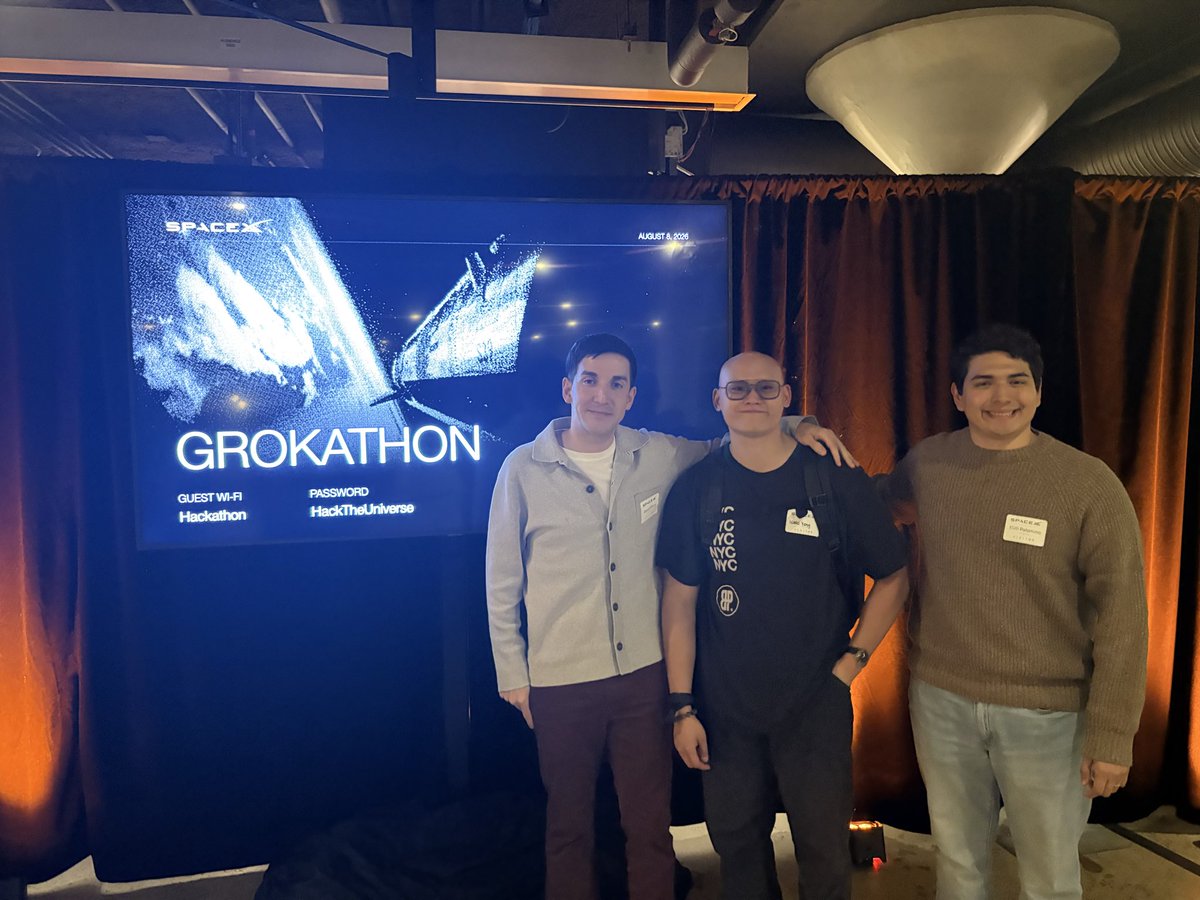
Official 3rd place at the SpaceXAI Grokathon — and the award for most users. This is the full recap of what we built, who we built it with, and everything I posted while it happened.
The event
SpaceXAI hosted Grokathon in San Francisco on Saturday, August 8, 2026. Selected builders got 12 hours with the latest Grok models and the X API. Winners were announced August 13. Ishan Deshpande organized it; I wrote that the event was extremely well run.
I had posted the invite on July 23: “Super excited to announce I’ve been invited to the @SpaceXAI Grokathon. Let’s build.”
What ThinkVoice is
From the official @SpaceXAI announcement (186k+ views):
3rd Place: ThinkVoice lets you speak without moving your mouth by combining Grok Voice with brain-sensing technology. It understands the conversation, suggests what you might want to say next, and lets you select a response using subtle motor movements.
During the build I described it this way:
You can interact with the app by making subtle head movements — nod to move, blink to select. Grok accesses your health metrics via Apple Health and knows the context of your current conversation, so it suggests responses you can choose from. Grok Voice’s latency and quality are remarkable, which can help people who have difficulty speaking or moving to have smooth conversations without extensive motion. Works on iPhone and Apple Watch.
Live product: thinkvoice.grok.me. Sense → choose → speak. Headset over Bluetooth (blink / nod / shake), or the front camera with on-device ARKit. Health, location, calendar, and reminders as permissioned context. Same talk loop on Apple Watch; the phone is the hub. Not a medical device — assistive voice software.
The team
@yangchasiu, @elithpalomino, and @Daniel_Farinax. Elith posted the first public demo during the night: an app that lets you speak without using your mouth by integrating Grok Voice with brain-sensing technology. I followed with our entry video: “ThinkVoice. Our entry for the Grokathon is ready.”
How the night went
- Afternoon — arriving for Grok 4.6: “Here I am, coming to get you, Grok 4.6.”
- Mid-build — “Still 4 hours at the Grokathon in San Francisco. So many talented teams building cool things. Very inspiring.”
- Late night — floor photos, merch, leftover energy.
- Entry locked — ThinkVoice video + thinkvoice.grok.me.
- Morning — “We made it to the top 6. Presenting next.”
- Podium — 3rd place. Then rest.


Official results
@SpaceXAI posted the podium on August 13. Nova took 1st (binary-to-C reverse engineering). Signal took 2nd (follower graph + engagement simulator). ThinkVoice took 3rd. I quote-posted their video with a ~4-minute recap of what we built — “Here’s the full recap of what we built for 3rd place (most users).”
Separate post the same night: “Won the award for most users. Thanks to all our users who supported us.”
What I noticed on the floor
After we placed I walked the room. A lot of builders were using Grok for the first time. People with design backgrounds avoided the CLI and stayed in Cursor Desktop or other GUIs. Quite a few still leaned Claude or Codex. My take: that has less to do with the tools than with how reluctant people are to try something new.
That observation is why I keep shipping GrokTerm, Xplor, and voice hosts — the gap is not only model quality. It is whether a capable person can sit down and finish something.
Why this belongs on a lab packet
ThinkVoice is the same thesis as GrokTerm, just aimed at people who cannot type or speak easily: put the model in a real control loop (sensors, Health, Watch), keep latency low, and let selection be tiny. In 12 hours we had a working assistive product, a public URL, a demo SpaceXAI used in the winner reel, and more users than the other teams.
If you run a frontier lab and you need people who ship interfaces around models — not just prompt them — this is the artifact.